


Key Takeaways:
- Children benefit from simple, honest explanations that confirm their parent is receiving help and that they did not cause the situation.
- Conversations should match the child’s age while providing practical reassurance about caregivers, routines, school, communication, and other daily needs.
- Consistent routines, emotional check-ins, healthy boundaries, and family support can help children feel safer while a parent is in treatment.
When a parent enters treatment, one of the hardest parts for many families is figuring out what to say to the children. The instinct to protect them is strong. Some adults want to wait until there is a perfect explanation. Others worry that saying too much will cause fear, while saying too little will leave kids confused. In reality, children usually notice when something has changed long before anyone sits down to explain it.
That is why honest, age-appropriate communication matters. Children do not need every detail about addiction, mental health, or treatment. They do need stability, clarity, and reassurance. They need to know that the adults in their lives are telling them the truth in a way they can handle. They also need help making sense of big changes without carrying blame that never belonged to them.
A clear conversation can reduce fear, ease confusion, and help preserve trust during a stressful time. It can also give children a healthier view of treatment itself. Rehab is healthcare designed to support healing and recovery. When a parent gets help, the goal is safety, healing, and a stronger foundation for the family moving forward. At Midwest Recovery Centers in Kansas City, MO, we support families through education and guidance because recovery affects everyone. For families looking into Rehab for parents in Missouri, this part of the process deserves just as much care as the treatment plan itself.
“One of the biggest mistakes families make is assuming children are too young to notice that something is wrong. Kids often sense far more than adults realize, and when they don’t have answers, they may blame themselves or imagine something even worse. Honest, age-appropriate conversations about a parent going to rehab can reduce fear, build trust, and help children understand that their parent is getting help and that they are not responsible for the situation.”
– Taylor Brown, CRADC
Why Children Need a Clear and Honest Explanation
Children are highly observant. Even when adults stay quiet, kids often notice tension, schedule changes, whispered conversations, missed routines, or a parent suddenly being away from home. When there is no explanation, children often fill in the gaps on their own. That can lead to fear, guilt, confusion, or false beliefs about what is happening.
A simple and truthful explanation helps reduce that uncertainty. It gives a child something steady to hold onto. It also teaches an important lesson early in life: when a family is facing something serious, the answer is not secrecy or chaos. The answer is support, treatment, and honest care.
Children often cope better when they know their parents are getting help, the situation is outside their control, and trusted adults are there to care for them. They also need space to ask questions and express their feelings openly.
Children may respond by becoming quiet, withdrawn, angry, or clingy. Others may appear fine at first and show their emotions later. A direct but calm explanation creates room for those feelings without making the child responsible for managing the adults around them.
It also helps protect the child’s trust. If they later realize everyone avoided the truth, they may feel excluded or misled. A child needs an age-appropriate version of the truth that feels emotionally manageable.
What Children Actually Need to Hear When a Parent Goes to Rehab
The most helpful explanation is usually the simplest one. Children do best with language that is clear, calm, and grounded. The goal is to help a child feel safer and less confused.
Most children need a few core messages repeated in different ways over time.
The parent is getting help
This is often the anchor point. A child may not fully grasp addiction treatment, mental health treatment, or co-occurring disorders, but they can recognize that a parent needs help from doctors, counselors, and other professionals.
Framing treatment as care matters. It lowers shame and makes the situation easier to process. When rehab is described as a place where people go to get support and get healthier, children are less likely to interpret the separation as punishment or abandonment.
The child did not cause this
Children often personalize adult problems, especially younger children. Even when they never say it out loud, some quietly wonder whether a fight, bad grade, or difficult day caused the parent to leave. That belief needs to be addressed directly.
This reassurance should not be implied. It should be stated clearly and more than once. Children need to hear that the parent’s need for treatment came from adult health issues, not anything the child did or failed to do.
The child will still be cared for
Even when the emotional conversation goes well, kids usually want practical reassurance too. They want to know who will pick them up, where they will sleep, who will make dinner, whether school stays the same, and when they may hear from the parent.
A child’s sense of safety often comes from routine. Specific information about daily life can help calm fears faster than broad reassurance alone.
It is okay to feel a lot of different things
Children do not react in one neat emotional pattern. Relief, sadness, embarrassment, anger, numbness, hope, and confusion can all exist at once. Some children want to talk immediately. Others need time. Some return with questions days or weeks later.
It helps to normalize emotional change rather than expecting one big conversation to settle everything. A child may need ongoing check-ins, not one final answer.
How to Talk to Children Based on Their Age and Stage
The same truth should be shared differently depending on the child’s age. A five-year-old, a ten-year-old, and a sixteen-year-old do not process stress in the same way. A good conversation matches the child’s developmental stage without becoming vague or evasive.
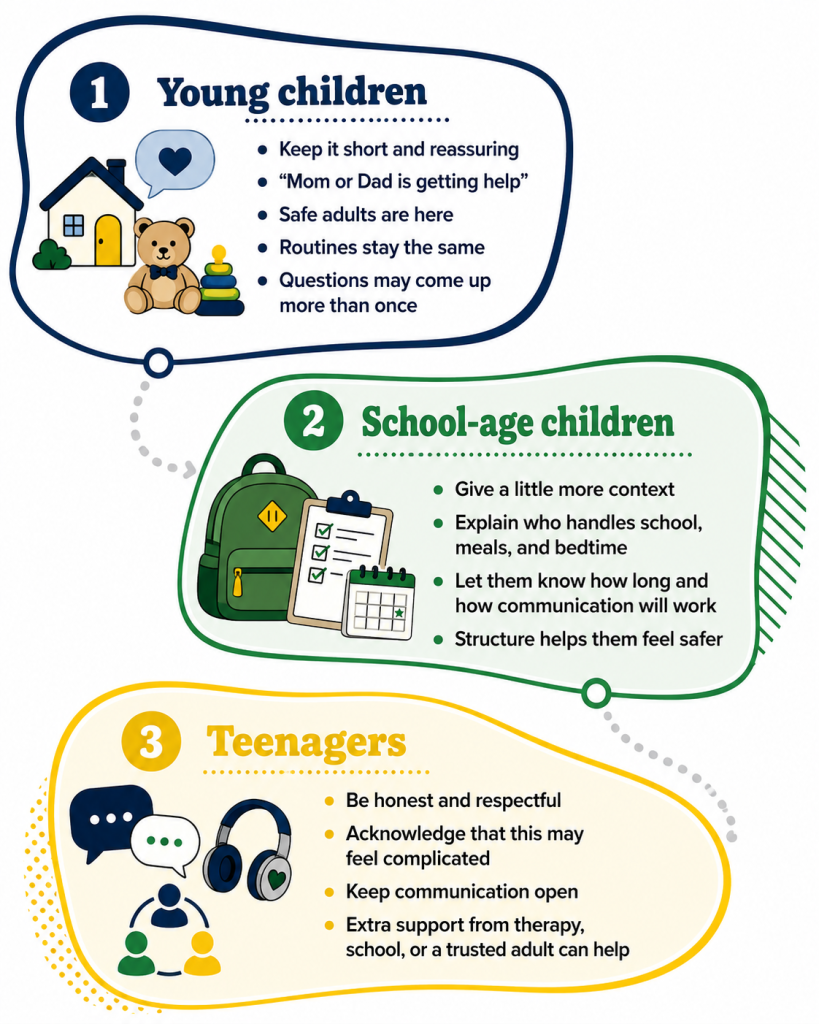
How to Explain Rehab to Children When a Parent Is in Treatment.png
What to Avoid When Explaining Rehab to Children
Even well-meaning adults can make the conversation harder by trying to soften it too much, overexplain it, or hide behind vague language.
A few common mistakes can increase confusion.
Avoid giving too much detail
Children do not need graphic stories, clinical labels they cannot process, or long explanations about everything that led to treatment. Too much information can feel heavy and destabilizing. The truth should be filtered through what is useful for the child, not through what the adults need to unload.
Avoid making promises that may not hold
It is tempting to reassure a child by saying everything will be fine soon. The problem is that children remember those promises. A better approach is to offer stability without pretending no hard feelings or setbacks exist.
It is more helpful to promise what can actually be delivered, such as continued care, honesty, and support.
Avoid blaming language
Children should not be pulled into adult frustration. Even if the situation has caused pain, the conversation with a child is not the place for blaming, venting, or assigning moral failure. Rehab should be described as treatment, not as proof that the parent is bad or broken.
Avoid secrecy that turns into confusion
Children can feel the difference between privacy and avoidance. One protects the family’s dignity. The other leaves a child alone with unanswered questions.
Avoid making the child responsible for the parent’s recovery
A child should never feel like they need to behave perfectly, stay quiet, earn the parent’s return, or help “fix” the situation. That is too much emotional weight for a child to carry.
How to Support Children During a Parent’s Time in Treatment
The conversation matters, but what happens after that conversation matters just as much. Children often cope best when the adults around them create steadiness in daily life and leave room for questions as they come up.
Support during treatment often looks simple from the outside, but those basics are powerful.
| Support Strategy | What It Can Include |
| Keep routines steady | Maintain school, meals, bedtime, and activitiesUse familiar caregivers when possibleGive children a dependable structure |
| Give simple updates | Share honest, age-appropriate informationExplain whether the parent is safeClarify when calls or visits may happenLeave out unnecessary clinical details |
| Help children name emotions | Check in without forcing conversationValidate sadness, anger, relief, or confusionEncourage drawing, movement, writing, or talkingConsider counseling when more support is needed |
| Maintain healthy adult boundaries | Keep adult stress and conflict away from childrenAvoid relying on them for emotional supportProtect them from adult-level responsibilitiesLet children remain in the role of being cared for |
Why Family Support Matters in Addiction Treatment
Addiction affects more than one person. Even when one parent is the one entering treatment, the whole family often feels the impact. That is one reason family support can be such an important part of care. Children benefit when the adults around them are also learning, growing, and getting support.
A strong family component can help create a healthier environment before, during, and after treatment. It can also help caregivers respond with more consistency, better communication, and less chaos.
For people looking for Rehab with Family Support in Kansas City, this piece matters. Treatment is not only about stopping substance use. It is also about building the conditions that support lasting change, healthier relationships, and more stable family life over time. Midwest Recovery Centers includes family programming as part of that broader approach to care.
Family support is helpful because it can:
- Reduce confusion about addiction and treatment
- Teach healthier boundaries
- Improve communication within the household
- Support children through transition and change
- Strengthen long-term recovery efforts after structured care ends
When family members receive education and support too, children often benefit indirectly. They are more likely to be surrounded by adults who can respond calmly, consistently, and with clearer expectations.
Services Available at Midwest Recovery Centers
When a parent needs treatment, families often need help learning more about what care is available and how it may fit around work, children, housing, and other responsibilities.
Midwest Recovery Centers provides comprehensive behavioral health treatment in the Kansas City area for addiction, primary mental health conditions, and co-occurring disorders. Our separate addiction and mental health facilities offer care ranging from detox and residential treatment to outpatient services, family programming, and aftercare.
Medical Detox and Residential Care for the First 30 Days
For clients entering the substance use treatment track, medical detox and residential care make up the first 30 days.
Detox provides medically supervised withdrawal support, followed by residential treatment with CBT, ACT, DBT, REBT, experiential groups, holistic activities, medical oversight, and 24/7 support.
Transitional Recovery and Extended Care
After the first 30 days, clients can continue into longer-term treatment:
- Phase 1: Approximately 60 days
- Phase 2: Up to nine months, depending on clinical need
Housing is included in both phases. These programs provide continued structure, accountability, and support as clients rebuild routines and prepare for more independent living.
Community IOP for Substance Use and Mental Health
Community IOP can be a strong option for parents who need structured treatment while continuing to work, care for children, or manage responsibilities at home.
Midwest Recovery Centers offers:
Medical oversight may include:
- Medication management
- Psychiatric evaluations
- TMS
- Long-acting injectable medications
- PGx genetic testing
- Telemedicine
Community IOP may be used as a step down from higher care or as a starting point when residential treatment is not needed.
Mental Health Treatment and Co-Occurring Care
Midwest Recovery Centers offers a 45-day Residential Mental Health Program for primary mental health conditions, including depression, anxiety, bipolar disorder, schizophrenia, personality disorders, and PTSD.
Outpatient mental health services are also available and can be a starting point when residential treatment is not appropriate.
For clients with both addiction and a mental health diagnosis, our shared treatment model provides coordinated care for substance use, psychiatric symptoms, medications, triggers, and recovery goals.
Personalized Clinical Services
Across levels of care, clients may receive individual therapy, group counseling, psychiatric care, medical support, experiential treatment, holistic activities, and personalized recovery planning.
PGx genetic testing is available across levels of care. We also treat problems involving alcohol, heroin, methamphetamine, cocaine, marijuana, prescription drugs, and other substances.
Family Program
Addiction and mental health conditions affect the entire household. Our Family Program gives loved ones practical education, communication tools, and guidance on how to support recovery without reinforcing unhealthy patterns.
Family services include:
- Virtual Substance Use Disorder Family Programming: Thursdays from 6:30 to 8:00 PM CST
- Virtual Mental Health Family Support: Third Thursday of each month at 8:00 PM CST
- In-Person Family Education: First Wednesday of each month at 7:00 PM
Aftercare Support
Aftercare helps clients maintain stability as they return to work, parenting, relationships, and everyday routines.
Support may include transition planning, counselor check-ins, individual and group therapy, relapse-prevention planning, and community resources. For parents, this can make the return home more structured and manageable.
How Treatment Can Help Parents Rebuild Trust With Their Children
Children do not expect perfection. What they need most is consistency, honesty, and emotional safety. Treatment can support that process, not because it instantly repairs every wound, but because it creates space for healthier patterns to begin.
When a parent commits to care, several things can start to shift:
- Communication often becomes more reliable
- Emotional reactivity may become easier to manage
- Routines can become more stable
- The child may feel less exposed to chaos or unpredictability
- The family can begin replacing confusion with a clearer structure
Trust usually rebuilds through repeated actions. A child may care deeply about a parent and still need time before they fully relax again, as it is part of the repair process.
Treatment can also help parents develop skills that matter at home, including emotional regulation, accountability, boundary setting, and healthier communication. Those changes can have a real impact on the family environment, especially when the child has lived with inconsistency for a long time.
Helping Children Feel Safe After a Parent Begins Treatment
Once treatment begins, the family often enters a different phase. The immediate crisis may feel less intense, but children still need support adjusting to a new normal. Safety is built over time through consistency, not through one conversation alone.
A few practices can help children feel more settled:
- Maintain regular routines whenever possible
- Keep caregiving responsibilities clear and predictable
- Let children know when updates are coming
- Use calm, age-appropriate language
- Make room for feelings without making the child manage the adults
This stage also benefits from patience. Some children seem relieved at first and react emotionally later. Others stay guarded even when things improve. A parent entering treatment is a meaningful step, but children may need time before they fully trust the stability around them.
Start Building a Stronger Future Together
Talking to a child about rehab can feel difficult, but calm, age-appropriate honesty can give them the reassurance and stability they need. Treatment can mark the beginning of a safer, healthier chapter for the entire family.
At Midwest Recovery Centers, we support patients and families through addiction treatment, mental health care, co-occurring disorder services, family programming, and aftercare. Contact our team today to explore your options, ask questions, and find the level of care that fits your family’s needs.
FAQs
What should I tell my child about a parent going to rehab?
Explain that the parent has a health problem and is receiving professional help. Reassure the child that they did not cause it and that trusted adults will continue caring for them.
How much information should children receive about addiction?
Share enough truthful information to reduce confusion without giving adult-level or graphic details. The explanation should reflect the child’s age, maturity, and questions.
How should rehab be explained to a young child?
Use short, concrete language. Tell them that their parent is sick, is staying somewhere safe to get help, and that their regular caregivers and routines will remain in place.
How can families support children during a parent’s treatment?
Families can maintain predictable routines, provide simple updates, encourage emotional expression, use familiar caregivers, and protect children from adult conflict and responsibilities.
What reactions might children have when a parent enters rehab?
Children may feel sad, angry, relieved, embarrassed, worried, or confused. Some react immediately, while others become quiet or ask questions days or weeks later.