


Key Takeaways:
- Early treatment plans focus on withdrawal, safety, sleep, nutrition, mental health symptoms, and helping the person become stable enough to participate in therapy.
- As thinking becomes clearer, treatment may address specific triggers, trauma, relationships, emotional regulation, family dynamics, and long-term relapse risks.
- Progress may lead to greater independence, while ongoing cravings, psychiatric symptoms, or home instability may require continued structure and a higher level of support.
Starting rehab can come with a lot of assumptions. Some people think the treatment plan is set on day one and stays the same until discharge. Others expect that once detox is over, the hardest part is done, and the rest will follow a straight line. In real treatment, that is rarely how it works.
The first stage of rehab is often about immediate needs. Safety comes first. Withdrawal symptoms have to be monitored. Sleep, appetite, mood, and basic daily functioning often need attention before a person can fully engage in deeper therapy. Once the body starts to settle and the mind becomes clearer, the clinical picture usually becomes much more detailed.
That shift is not a problem. It is one of the signs that treatment is doing what it should. A strong addiction treatment plan is meant to adjust as the person stabilizes, responds to care, and reveals needs that were harder to see in the early days. What looked like a straightforward substance use issue at intake may turn out to involve trauma, depression, panic, bipolar symptoms, grief, or a home environment that raises relapse risk. In other cases, the original plan was appropriate, but the person becomes ready for different goals, new responsibilities, or a less intensive level of care.
At Midwest Recovery Centers, treatment is built around that kind of movement. As a provider offering every level of care from detox to long-term extended support, the team works to match care to the person instead of forcing the person to fit one rigid track. That is part of what makes personalized rehab in Kansas City more meaningful for people who need real structure, clinical support, and a plan that keeps evolving as recovery takes hold.
“The treatment plan someone needs on day one of rehab is rarely the same plan they need a few weeks later. Early in recovery, the focus may be on safety, stabilization, and getting through the immediate crisis, but as the fog begins to lift, deeper issues like trauma, relationships, mental health, and relapse prevention often come into focus. The most effective rehab programs continually adapt the treatment plan to match a person’s progress, challenges, and evolving recovery goals.”
– Taylor Brown, CRADC
Why Does A Treatment Plan Change After Rehab Begins?
A treatment plan changes because the first few days of rehab rarely show the full picture. Intake gives the team a starting point, but stabilization reveals much more. Once substances begin clearing from the body, new symptoms can appear, old symptoms can return, and the person’s actual strengths and challenges become easier to assess.
Addiction affects more than substance use. It can disrupt sleep, thinking, mood, relationships, appetite, stress tolerance, impulse control, and the ability to follow through with care. Some clients arrive feeling physically miserable and emotionally guarded. Others come in determined to move fast, only to realize a few days later that deeper issues have been driving the cycle all along.
A good addiction treatment plan should be flexible enough to respond to those changes. That may mean adjusting therapy goals, changing the level of care, adding mental health support, increasing structure, or preparing the client for more independence as stability improves.
Several things commonly shape these changes:
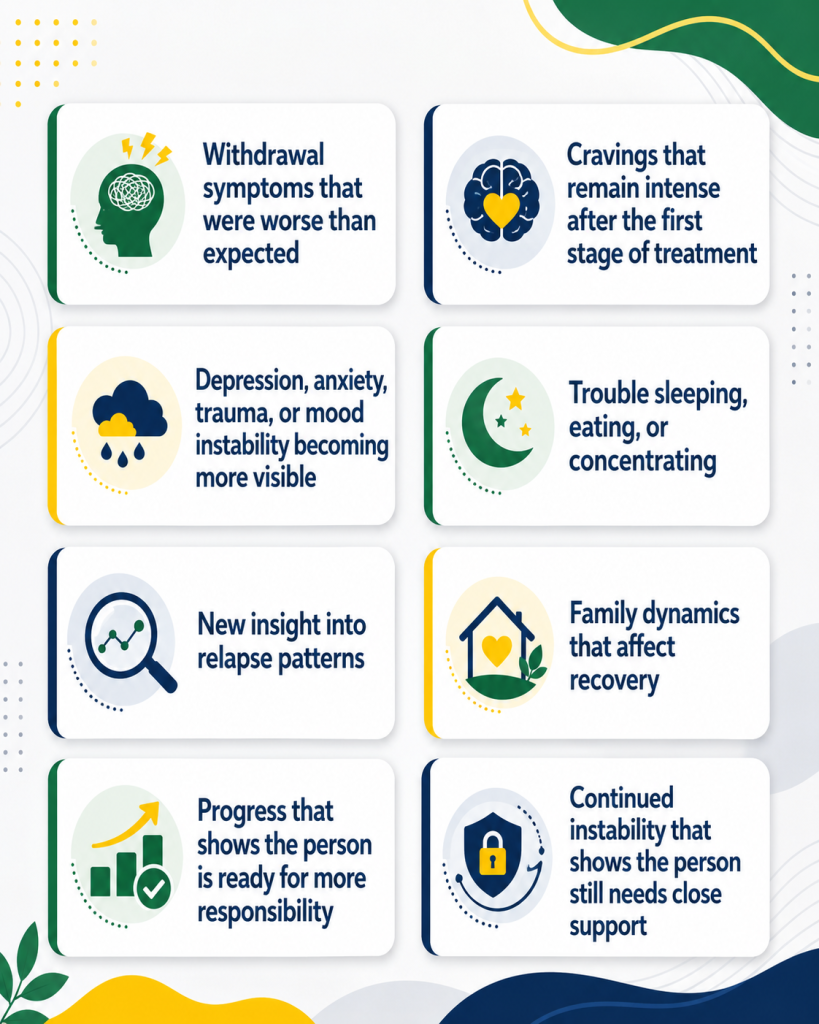
How Treatment Plans Change as You Stabilize in Rehab.png
This is one reason personalized care matters so much. The best plan is not the one that looks neat on paper. It is the one that keeps responding to what is actually happening in real time.
What is The Team Focused On During The First Stage of Rehab?
The early stage of rehab is mostly about stabilization. Before someone can do their best therapy work, the body and brain need a chance to settle. For many clients, those first days are marked by physical discomfort, emotional intensity, low energy, disrupted sleep, and a lot of mental noise.
During this stage, the treatment team is usually watching closely for:
- Withdrawal symptoms
- Medical concerns
- Psychiatric symptoms
- Sleep problems
- Appetite and hydration issues
- Agitation, confusion, or emotional instability
- Safety concerns
- Readiness to participate in groups and individual sessions
At Midwest Recovery Centers, the substance use track begins with Medical Detox and Residential, which serves as the first 30 days before Phase 1. This opening stage is designed for people who need supervised detoxification followed by structured residential treatment. That level of care is important because the first phase of recovery often requires more support than people expect.
This first stage gives the team time to observe patterns. A person may come in believing they only need a short reset, but the first weeks can show whether cravings remain intense, whether mental health symptoms are surfacing, and whether the person is ready to step down or still needs more structure.
What Starts to Change Once The Body Begins to Stabilize?
Once physical stabilization begins, treatment usually shifts from crisis management into deeper clinical work. That does not mean the person is suddenly “finished” with the hard part. It means the focus broadens. Instead of only reacting to immediate symptoms, the team can start working on what has been feeding the addiction over time.
This stage often brings clearer thinking, improved sleep and appetite, and more stable emotional responses. When that happens, the client is often better able to look honestly at behavior patterns, triggers, relationships, mental health symptoms, and relapse risks.
At that point, the addiction treatment plan may begin to change in several ways.
Therapy goals often become more specific
Early treatment goals often focus on safe withdrawal, better sleep, group participation, and staying engaged in care. As progress continues, the plan may shift toward relapse triggers, emotional regulation, trauma or grief, healthier routines, stronger boundaries, accountability, and greater awareness of self-sabotaging patterns.
The client’s role becomes more active
As people stabilize, they can usually take a more active role in treatment planning. They may be able to identify what situations make them vulnerable, what coping tools are working, and what kind of support they still need.
The team may adjust intensity
Some people begin showing signs that they are ready for more independence. Others reveal that they still need a highly structured setting. This is where treatment planning becomes less theoretical and much more personalized.
That shift is one of the most important parts of rehab. The person is no longer only being carried through a crisis. They are starting to build the skills and self-awareness that recovery will depend on after discharge.
When Do Mental Health Needs Start Changing The Plan?
Mental health needs often become clearer after the initial physical crisis starts to calm down. For some people, emotional symptoms were present all along but were being masked by active substance use. For others, those symptoms intensify when substances are removed, and the nervous system has to function without them.
This is often the point where the team starts asking harder questions. Is the person dealing mainly with addiction, or is there also depression, anxiety, panic, trauma, bipolar disorder, psychosis, or another condition shaping behavior and recovery? Does the client need more psychiatric support? Do medications need review? Would a mental health-focused level of care make more sense at some point?
These questions matter because untreated mental health symptoms can quietly unravel progress. A person might be staying away from substances while still feeling emotionally overwhelmed, unable to sleep, deeply hopeless, or stuck in cycles of panic and irritability. If those issues are not addressed, relapse risk can stay high even when someone appears motivated.
At Midwest Recovery Centers, co-occurring disorders support is a core part of care. The program emphasizes treating clients who have both addiction and a mental health diagnosis through a shared treatment model. That allows the care team to respond when the plan needs to expand beyond substance use alone.
How Do Structure and Expectations Shift as Progress Grows?
As clients become more stable, treatment gradually shifts from crisis support toward greater independence. Structure remains in place, but clients begin taking a more active role in applying recovery skills and preparing for life beyond the most protected setting.
| Area of Focus | How Treatment May Change | Why It Helps |
| Accountability | More involvement in treatment planningIndependent use of coping skillsHonest reflection on behavior | Builds ownershipStrengthens decision-makingSupports long-term change |
| Daily life skills | Time managementCommunicationConflict resolutionEmotional regulationBoundariesRoutine building | Creates greater stabilityImproves daily functioningHelps rebuild a balanced life |
| Relapse prevention | Identifying triggersReviewing relationshipsManaging work stressAddressing mental health symptomsPlanning for housing and social risks | Reduces avoidable riskStrengthens coping strategiesPrepares clients for real-life challenges |
| Step-down preparation | Planning the next level of careIncreasing independence graduallyContinuing housing and accountability when neededBuilding community support | Prevents sudden transitionsMaintains recovery supportCreates a safer path forward |
Moving forward does not always mean receiving less care. In many cases, it means receiving a different type of support that offers more independence while preserving structure, accountability, and connection.
What Happens If Someone Is Not Ready to Step Down Yet?
Every person stabilizes on their own unique timeline. Some move through the first stage of rehab and become ready for more independence fairly quickly. Others continue to struggle with cravings, emotional swings, poor sleep, psychiatric symptoms, or a high-risk home environment. When that happens, keeping the original plan just because it was the original plan can do more harm than good..
Signs that someone may still need a higher level of support include:
- Ongoing intense cravings
- Poor emotional regulation
- Unstable mood or anxiety symptoms
- Trouble engaging honestly in treatment
- Continued sleep disruption
- High relapse risk if returned to a less structured setting
- Strong influence from unsafe relationships
- Limited insight into personal triggers
- Difficulty managing responsibilities without close support
What Does Personalized Rehab in Kansas City Look Like?
Personalized rehab in Kansas City should look like a treatment plan that keeps changing with the client instead of treating every stage the same. Real personalization is not just using someone’s name in a care meeting or offering a few elective therapy options. It is the ongoing clinical process of adjusting care as the person stabilizes, reveals new needs, and builds more capacity.
That kind of personalization often shows up in practical ways.
The plan reflects current symptoms, not only intake notes
What someone said on the first day matters, but it should not control the entire course of care if new information emerges later.
The level of care matches the person’s actual risk
Some clients need detox and residential treatment first. Some need long-term support with housing. Some need Community IOP. Some need primary mental health treatment. The care plan should reflect those differences.
Mental health and addiction are treated together when needed
A client with anxiety, depression, trauma, bipolar symptoms, or psychosis should not be treated as if substance use exists in isolation.
Family and environment are taken seriously
Recovery can be affected by home life, boundaries, enabling patterns, and the amount of support waiting outside treatment.
The person is treated as a whole human being
That includes mind, body, and day-to-day functioning, not just symptoms on a checklist.
Midwest Recovery Centers leans into that whole-person approach. We emphasize treating the person’s mind, body, and spirit while also maintaining values around inclusivity, equity, service, and teachability. We also keep facilities small and care deeply personal, which can help clients feel seen instead of processed.
When treatment is personal enough to notice changes early, the addiction treatment plan can shift sooner, and those adjustments tend to be more effective.
Services Midwest Recovery Centers Offers
A full continuum of care matters because treatment plans often need to move through more than one level. Midwest Recovery Centers offers a wide range of behavioral health services in the Kansas City area, which makes it possible for the treatment plan to adapt without sending clients through a disconnected system.
Substance use disorder treatment
The substance use track begins with Medical Detox and Residential, which serves as the first 30 days before Phase 1. This stage includes supervised detoxification from alcohol or drugs followed by residential care with evidence-based therapies such as CBT, ACT, and DBT, along with holistic activities and experiential group therapy.
After that, clients can continue into Transitional Recovery and Extended Care, which is structured in three phases:
- Medical Detox and Residential for the first 30 days
- Phase 1 for about 60 days
- Phase 2 for up to 9 months, depending on need
Housing is part of both Phase 1 and Phase 2, which provides continued structure for clients who still need a highly supportive setting while building long-term recovery skills.
Community IOP
Midwest Recovery Centers offers two Community IOP programs:
These programs are especially useful for people who do not want to, or are not able to, commit to the long-term housing portion of treatment. Both include medical oversight that may involve:
- Medication management
- Psychiatric evaluations
- TMS or Transcranial Magnetic Stimulation
- LAI or Long Acting Injectables
- Genetic testing
- Telemedicine
Mental health treatment
The Residential Mental Health Program is a 45-day program designed to treat primary mental health disorders, not only mental health symptoms that occur alongside addiction. Midwest Recovery Centers also offers outpatient mental health services, which can be used independently or as part of a broader treatment plan.
Co-occurring disorders support
Clients dealing with both addiction and mental health symptoms can receive care through a shared treatment model, which helps the team address both conditions at the same time.
Family program
Recovery affects more than one person, so family support is built into the care model.
- Virtual Substance Use Disorder Family Programming
- Thursdays from 6:30 to 8:00 PM CST in a four-part monthly rotation
- 1st Thursday
What Am I Dealing With - 2nd Thursday
Why Can’t I Fix My Loved One - 3rd Thursday
How Do I Stop Participating in the Addiction Cycle - 4th Thursday
What Does Family Recovery Look Like
- 1st Thursday
- Thursdays from 6:30 to 8:00 PM CST in a four-part monthly rotation
- Virtual Family Program for Mental Health
- 3rd Thursday of the month at 8:00 PM CST
- In-Person Family Education
- Supporting Their Next Steps An Aftercare Info Session for Families
- 1st Wednesday of the month at 7:00 PM
- Main Outpatient Campus
13340 Holmes Rd, Kansas City, MO 64145
- Main Outpatient Campus
Aftercare
Midwest Recovery Centers’ Aftercare program supports long-term sobriety, especially during the first year after treatment. It includes personalized plans, regular counselor check-ins, individual and group therapy, relapse-prevention planning, and community support as clients transition back into everyday life.
When a program offers all of these services, the treatment plan has room to grow and change instead of hitting a wall.
How Do Families Fit Into Treatment Plan Changes?
Family involvement can matter a great deal as treatment evolves, because recovery does not happen in isolation. A person’s progress can be helped or hurt by what is waiting outside the treatment setting.
As clients stabilize, the treatment team may begin looking more closely at:
- Family stress
- Codependency patterns
- Enabling behavior
- Communication problems
- Boundary issues
- Home triggers
- Emotional wounds that affect relapse risk
Those factors can shape the next phase of treatment just as much as the client’s personal progress. If the home environment is chaotic or the family system is stuck in unhealthy roles, the person may need more time in structured care or more support before stepping down.
This is one reason family programming can be so useful. It gives loved ones a way to learn about addiction, recovery, boundaries, and their own role in the process. It also gives them a place to build healthier expectations rather than reacting from panic, guilt, or frustration.
A changing treatment plan is often easier to support when everyone involved has a clearer sense of why the changes are happening.
Why Is a Changing Plan Often a Sign of Better Care?
A changing plan is often a sign that the treatment team is paying attention. Rigid care can look organized from the outside, but it often misses the person standing in front of it. Better care tends to be responsive. It notices when someone is stabilizing, when someone is stuck, when new symptoms are surfacing, and when a person is ready for more responsibility.
That kind of care supports real progress because it keeps asking the right question of “What does this person need now?”
At Midwest Recovery Centers, that question can lead clients through medical detox and residential care, long-term structured support with housing, Community IOP, mental health services, family programming, and aftercare based on what their recovery actually requires. That full continuum allows the addiction treatment plan to evolve with purpose instead of remaining static.
Treatment should move as the person moves. It should respond as the client becomes clearer, stronger, more honest, and more capable of doing the deeper work that lasting recovery depends on.
Let’s Talk About The Right Next Step Today
Treatment plans should evolve as a person becomes more stable. Early care may focus on safety, withdrawal, and basic functioning, while later stages often become more personalized and centered on long-term recovery, stronger coping skills, and preparation for everyday life.
At Midwest Recovery Centers, we provide a full continuum of care that allows treatment to adjust as each client’s needs change. Contact our team today to explore your options, ask questions, and take the first step toward a treatment plan that truly fits.
FAQs
Why do treatment plans change after rehab begins?
Intake provides an initial picture, but stabilization often reveals additional symptoms, relapse patterns, mental health needs, and environmental risks that require the plan to be adjusted.
What does the treatment team focus on during early rehab?
Early care usually prioritizes withdrawal management, physical safety, sleep, appetite, hydration, psychiatric symptoms, emotional stability, and readiness to participate in treatment.
How can mental health symptoms change an addiction treatment plan?
Depression, anxiety, trauma, bipolar symptoms, psychosis, or sleep problems may require psychiatric care, medication review, specialized therapy, or a different level of treatment.
What happens when someone becomes more stable in rehab?
The person may take a more active role in treatment planning, practice coping skills independently, accept greater responsibility, and begin preparing for a less intensive level of care.
What if someone is still not ready to step down?
Continued cravings, unstable moods, poor sleep, limited insight, unsafe relationships, or high relapse risk may lead the team to recommend more time in structured treatment.