


Key Takeaways:
- Couples may enter treatment during the same period, but each partner must qualify for care based on the patient’s clinical needs.
- Partners may require different levels of care, including detox, residential treatment, mental health care, or outpatient services.
- Shared housing, schedules, therapy, or discharge dates should not be assumed when both partners enter treatment at the same time.
When both partners are struggling with alcohol or drug use, the need for treatment can become clear at the same moment. A frightening overdose, repeated arguments, financial pressure, legal trouble, or another failed attempt to stop may leave both people ready to make a change.
Seeking help together can feel practical. Neither person has to remain at home using substances while the other enters care. Both can step away from the routines and relationship patterns that have kept addiction active. Still, entering treatment on the same day is not as simple as reserving one placement for two people.
Each partner has separate medical, psychiatric, and substance-use needs. One may require supervised detox, while the other may be ready for residential treatment or Community IOP. Their withdrawal risks, medications, mental health symptoms, and treatment goals may also differ.
For that reason, couples may be able to pursue treatment at the same time, but admission must be evaluated individually. A program should never promise shared housing, identical schedules, or joint therapy without first reviewing clinical needs, safety concerns, available space, and facility policies.
At Midwest Recovery Centers, we personalize care for each person through individual assessments, therapy, family support, and multiple levels of treatment. While we do not offer a dedicated couples residential program or guarantee shared housing, our admissions team can help couples explore treatment options at the same time.
“When couples enter treatment at the same time, the goal isn’t to make their recovery plans identical—it’s to make sure each person receives the level of care they actually need. With couples inpatient rehab in Kansas City, one partner may need medical detox while the other is ready for residential or outpatient treatment. Individual assessments, separate treatment plans, and clear boundaries give both partners space to focus on their own recovery while still addressing the relationship in a healthy and clinically appropriate way.”
– Taylor Brown, CRADC
Can Spouses Attend Rehab Together?
Two spouses can seek treatment during the same period, but each person must qualify for the recommended level of care on their own.
Spouses attending rehab together can mean several different things. A couple might be asking whether they can:
- Be admitted on the same day
- Receive care through the same treatment organization
- Live in the same residential facility
- Share a room
- Attend therapy groups together
- Have couples counseling during treatment
- Move through each treatment phase on the same schedule
Those arrangements are not interchangeable.
A treatment provider may be able to admit both partners during the same general period without housing them together or placing them in the same clinical groups. In other cases, one partner may begin in detox while the other starts residential or outpatient care. Separate facilities may also be recommended when the relationship creates safety concerns or interferes with either person’s ability to focus.
The admissions team must look at both people as individual clients. Being married, engaged, dating, or living together does not make their clinical needs identical.
What Does Couples Inpatient Rehab in Kansas City Actually Involve?
Many families use “inpatient rehab” as a general term for treatment that includes housing and continuous support. Programs may use more specific names, such as medical detox, residential treatment, inpatient care, transitional recovery, or extended care.
A search for couples inpatient rehab Kansas City may bring up programs with very different structures. Some specialize in couples treatment. Others accept both partners but keep treatment completely separate. Certain facilities may treat only one partner at a time.
Before choosing a program, clarify what “together” means at that specific facility.
Questions to address with admissions include:
- Can both partners complete screenings at the same time?
- Is each person assessed separately?
- Are simultaneous admissions possible?
- Would both people stay at the same location?
- Are sleeping arrangements separate?
- Could one partner’s discharge affect the other’s placement?
- Does the program provide couples counseling?
- How is privacy protected?
- What happens if one partner leaves treatment early?
- Are there safety rules about contact during treatment?
At Midwest Recovery Centers, admission begins with a confidential conversation about the person’s specific needs. Each client receives an individualized treatment plan, and clients in addiction treatment are assigned personal therapists.
Those safeguards remain important even when both members of a couple enter care during the same period.
Why Does Each Partner Need a Separate Assessment?
Addiction may affect a couple as a unit, but treatment decisions are made one person at a time.
A joint admissions conversation may help gather basic information, yet each partner also needs private space to discuss substance use, mental health, medications, relationship concerns, and personal safety.
Withdrawal Risk May Be Different
One person may drink heavily every day and face dangerous alcohol withdrawal. The other may primarily use stimulants or marijuana and have a different set of symptoms.
Detox recommendations can be affected by:
- The primary substance used
- Use of multiple substances
- The amount and frequency of use
- The time of the last drink or dose
- Previous withdrawal seizures
- Past episodes of delirium
- Overdose history
- Pregnancy
- Chronic medical conditions
- Current medications
A partner who needs medical detox should not skip that level simply to stay on the same schedule as their spouse.
Mental Health Needs May Not Match
Depression, anxiety, trauma symptoms, bipolar disorder, personality disorders, or other psychiatric concerns may affect treatment placement.
One partner might have a primary substance use disorder with mild anxiety. The other may have severe mental health symptoms that require a dedicated residential mental health program.
Midwest Recovery Centers provides addiction treatment, primary mental health treatment, and support for co-occurring conditions. Our programs are built around personalized care rather than placing every client on the same track.
Motivation Can Be Uneven
One person may be ready to participate fully, while the other is entering mainly to avoid separation or conflict.
Treatment teams need to evaluate whether each partner is making a personal commitment to care. Entering solely to monitor a spouse can make it difficult to engage honestly in therapy.
Both people do not need to feel completely confident before admission. Fear and uncertainty are common. Still, each person must be willing to participate in their own treatment rather than treating rehab as something they are doing only for the relationship.
Medical Needs Can Change Placement
Diabetes, heart disease, liver disease, chronic pain, seizure disorders, mobility concerns, or recent hospital treatment can affect the safest starting point.
One spouse may be appropriate for residential detox, while the other needs emergency or hospital stabilization before entering behavioral health care.
A coordinated start can still be possible, but safety must come before matching admission dates.
When Can Entering Treatment at the Same Time Be Helpful?
Simultaneous treatment may remove several barriers when both partners genuinely want help.
If one spouse enters residential care while the other continues using at home, both may face added pressure. The person in treatment may worry about their partner’s safety. The spouse at home may feel abandoned, become more isolated, or continue using in the same environment.
When both begin appropriate care, several positive changes may become possible.
The Home Substance-Use Pattern Is Interrupted
Couples may develop routines in which obtaining, using, hiding, or recovering from substances becomes part of daily life.
Entering treatment at the same time can interrupt:
- Shared access to alcohol or drugs
- Mutual excuses for continued use
- Arguments followed by substance use
- Financial patterns tied to addiction
- Social circles centered on using
- One partner rescuing the other from consequences
Physical separation during early treatment may also create enough space for each person to examine these patterns more honestly.
Both Partners Begin Learning New Skills
Recovery can become strained when one person changes while the other continues living by the old rules.
When both partners receive care, each may begin working on:
- Identifying triggers
- Managing cravings
- Regulating emotions
- Communicating more directly
- Setting healthy boundaries
- Rebuilding daily routines
- Taking responsibility for personal choices
- Preparing for relapse risks
Their treatment plans may differ, but learning healthier skills during the same period can create a stronger base for life after residential care.
The Relationship Can Be Addressed at the Right Time
Research on behavioral couples therapy has found that partner involvement can support substance-use and relationship outcomes in some clients. However, behavioral couples therapy is a specific clinical service. It is not the same as sharing a residential room or completing every part of treatment side by side.
Relationship-focused work may be useful after both partners have reached enough stability to participate safely and honestly. Early treatment may need to focus first on withdrawal, medical stabilization, psychiatric symptoms, and accountability.
When Might Separate Treatment Be the Safer Choice?
Entering care at the same time is not always the healthiest arrangement.
A clinical team may recommend separate facilities, limited contact, or different admission dates when the relationship could distract from treatment or place someone at risk.
One Partner Regularly Triggers the Other
A couple may associate each other with obtaining substances, hiding use, or returning to use after periods of abstinence.
Constant contact during early care can keep those associations active. Separate treatment environments may give both people room to form healthier routines and develop identities outside the relationship’s substance-use pattern.
The Relationship Includes Control or Coercion
Private screening is essential when one partner controls money, transportation, communication, medications, or access to treatment.
No one should feel pressured to:
- Share private clinical information
- Approve a partner’s treatment decisions
- Attend joint sessions
- Remain in contact
- Enter or leave treatment on the same day
- Stay in a relationship to receive care
Substance-use programs should screen for safety concerns and adapt treatment when domestic violence, threats, or controlling behavior may be present. SAMHSA guidance emphasizes identifying domestic violence and modifying treatment planning to protect safety.
In these situations, couples therapy may not be appropriate. Safety planning and separate care take priority.
One Partner Is Focused on Monitoring the Other
Residential treatment requires attention to personal behavior, emotions, and choices.
A spouse who spends each day checking whether their partner is attending groups, taking medication, or following rules may avoid their own clinical work. The other person may also feel watched and become less honest with staff.
Separate therapists, private records, and clear communication boundaries help prevent treatment from turning into another form of relationship supervision.
Their Clinical Needs Are Too Different
One partner may need medical detox and months of extended addiction treatment. The other may be better suited for primary mental health residential care or an outpatient program.
Trying to force both people into the same level of care can lead to:
- Insufficient medical support
- Treatment that is more restrictive than necessary
- Missed mental health needs
- Premature discharge
- Resentment about different progress
- Pressure to leave when the other partner leaves
Good care follows clinical need, even when that means the couple spends part of treatment in different programs.
How Does Privacy Work When Both Partners Are in Treatment?
Marriage does not remove a client’s right to privacy. Each spouse has separate treatment records, clinical conversations, assessments, and medication information. Staff cannot automatically tell one partner what the other discussed in therapy or how they are progressing.
A client may sign a release allowing certain information to be shared. Even then, the release should specify what can be discussed and with whom.
Healthy privacy gives each partner room to speak honestly about substance use, relapse, mental health symptoms, trauma, relationship stress, concerns about returning home, personal treatment goals, and how safe the relationship feels.
The couple may later participate in approved family or relationship sessions. Those sessions should have a clear clinical purpose rather than serving as a way for either spouse to obtain access to the other’s private treatment.
How Can Couples Work on the Relationship During Rehab?
A couple does not need to complete every treatment activity together for the relationship to improve.
Often, the most valuable early work happens separately. Each person begins examining personal behavior, emotional reactions, relapse patterns, and the effect their substance use has had on others.
Relationship work may later focus on:
- Communicating without threats or blame
- Separating support from enabling
- Setting boundaries around substances
- Responding to cravings or setbacks
- Rebuilding trust over time
- Managing money and household responsibilities
- Creating a sober home environment
- Planning for different discharge dates
- Supporting treatment without controlling it
SAMHSA recognizes family therapy and family participation as useful components of substance-use care. Family services can help address communication, boundaries, roles, and the larger system surrounding addiction.
Still, family education, family therapy, and couples therapy are different services. Availability depends on the program, clinical plan, and safety of everyone involved.
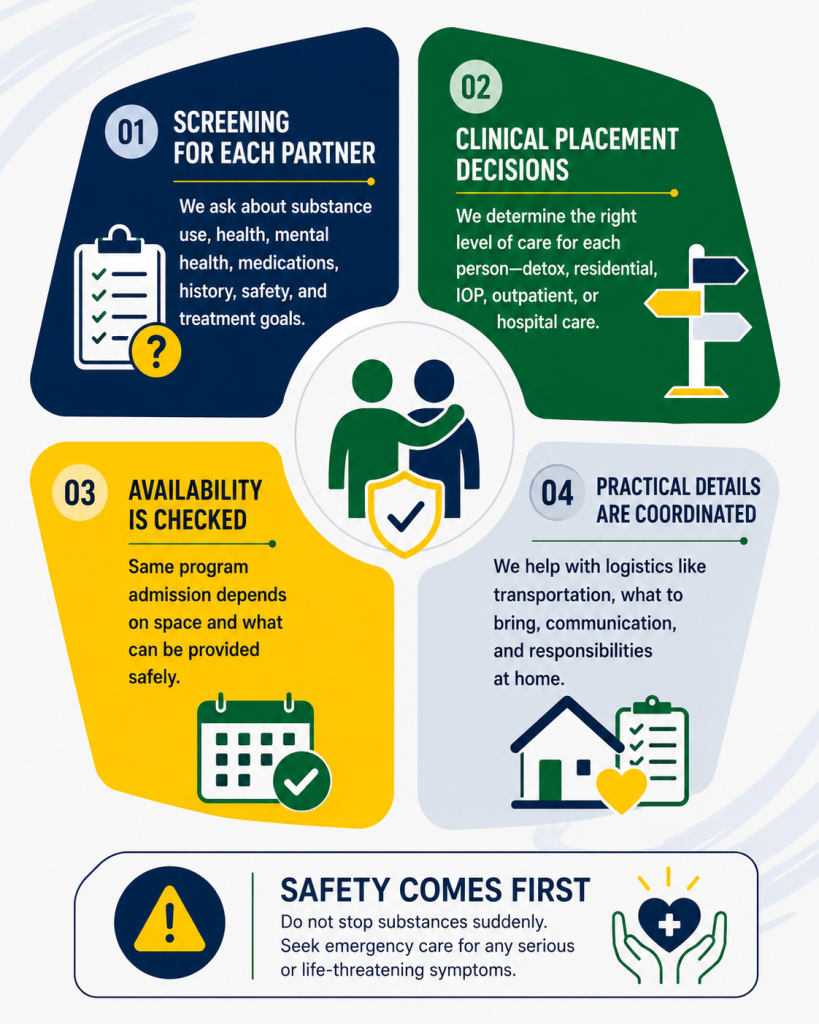
What Does the Admissions Process Look Like for a Couple?
Couples can begin by contacting the treatment center and explaining that both partners are seeking care.
The process will usually require separate information for each person.
Midwest Recovery Centers Services
Midwest Recovery Centers was founded in 2016 to fill a gap in comprehensive behavioral health treatment in the Kansas City area. We have dedicated programming for addiction and primary mental health conditions, along with coordinated support for clients who experience both.
We are the region’s only private provider offering every level of care, from detox to long-term extended support. Our facilities remain small so care can stay personal, responsive, and centered on the patient.
Our philosophy addresses the whole person, including mind, body, and spirit, while emphasizing inclusivity, equity, service, and teachability.
Detox and Residential Addiction Treatment
Detox and Residential care make up the first 30 days of our substance use track.
Medical Detox provides supervised care as alcohol or drugs leave the body. Medication-assisted treatment is offered during Detox only when clinically appropriate.
Residential care adds structure and evidence-based treatment, including:
- Cognitive behavioral therapy
- Acceptance and commitment therapy
- Dialectical behavior therapy
- Rational emotive behavior therapy
- Experiential group work
- Holistic activities
- Psychoeducation
- Support-group integration
- Individual therapy
- Ongoing medical and psychiatric assessments
Our substance-use services address alcohol, heroin and other opioids, methamphetamine, cocaine, marijuana, prescription drugs, and use involving multiple substances.
Phase 1 and Phase 2 Extended Care
Clients may transition from the first 30 days into Phase 1 for approximately 60 days.
Phase 2 may continue for up to nine months, depending on clinical need. Housing is included in both phases.
This extended-care model works much like continuing inpatient support. Clients gain more independence while remaining connected to structure, clinical services, accountability, peers, and stable housing.
For couples, one partner may advance to a later phase before the other. Each person’s timing is based on progress and clinical recommendations rather than the relationship schedule.
Community IOP for Substance Use and Mental Health
We provide two Community Intensive Outpatient Programs:
- Community IOP for Substance Use Disorder
- Community IOP for Mental Health
Community IOP serves patients who do not want, or are not able, to commit to long-term program housing. It can also provide continued structure following a higher level of care.
Medical oversight is available across both Community IOP tracks and may include:
- Medication management
- Psychiatric evaluations
- Transcranial Magnetic Stimulation
- Long-Acting Injectable medications
- PGx genetic testing
- Telemedicine
Midwest Recovery Centers’s current Community IOP materials confirm that we provide separate full-service outpatient tracks for substance use and mental health needs.
Community IOP may allow both partners to live at home while attending care, but each person still receives a personalized clinical recommendation. Living together during outpatient treatment should be reviewed carefully when the home environment includes active substance use, conflict, or safety concerns.
Residential Mental Health Treatment
Our 45-day Residential Mental Health Program treats primary mental health disorders, not only symptoms that occur alongside addiction.
The program combines a structured living environment with:
- Individualized therapy
- Psychiatric care
- Medication management
- Primary care support
- TMS
- Precision medicine
- Nutrition
- Fitness
- Case management
- Whole-person activities
Midwest Recovery Centers’s residential mental health program is designed around individualized 45-day care and coordinated support for physical, mental, emotional, and spiritual wellness.
One partner may enter addiction treatment while the other receives primary mental health care. Placement in separate programs can still support the relationship by giving each person clinically appropriate treatment.
Outpatient Mental Health Services
Outpatient mental health care may follow residential treatment, but it does not have to.
A client can begin with outpatient services when symptoms can be managed safely without residential support. This flexibility matters when one spouse requires a residential setting and the other needs structured mental health treatment while continuing to live at home.
Co-Occurring Disorder and Clinical Care
Our shared treatment model addresses addiction and co-occurring mental health diagnoses without treating them as unrelated issues.
Clinical services include:
- Medical and psychiatric assessments
- Personalized treatment plans
- Medication oversight
- Individual goals
- Ongoing progress reviews
- Coordination across appropriate levels of care
PGx genetic testing is available at all levels of care. Results may provide added information about how a client could process certain psychiatric medications, supporting individualized prescribing decisions.
Family Programming
Our Family Program provides education, counseling, and support for loved ones affected by addiction or mental illness. It can help couples learn healthier forms of support even when their primary treatment remains individual.
Virtual Substance Use Disorder Family Programming takes place Thursdays from 6:30 to 8:00 p.m. Central Time through a four-part monthly rotation:
- First Thursday: Addiction education, causes, family dynamics, and what to expect at Midwest Recovery Centers
- Second Thursday: Enabling, healthy support, grief, and codependency
- Third Thursday: Boundaries before, during, and after treatment
- Fourth Thursday: Detaching with love, self-care, and changing family roles
Our Virtual Family Program for Mental Health meets on the third Thursday of each month at 8:00 p.m. Central Time.
In-person family education, “Supporting Their Next Steps: An Aftercare Info Session for Families,” takes place on the first Wednesday of each month at 7:00 p.m. at our Main Outpatient Campus, 13340 Holmes Road, Kansas City, Missouri 64145.
Midwest Recovery Centers’ current Family Program materials emphasize education, counseling, boundaries, and separate support tracks for substance use and mental health.
Aftercare
Our Aftercare program supports clients as they move from structured treatment into everyday life, particularly during the first year.
Care may include:
- Personalized continuing-care plans
- Counselor check-ins
- Individual or group therapy
- Relapse-prevention planning
- Goal reviews
- Community support
- Adjustments as needs change
Couples may benefit from developing separate relapse-prevention plans alongside shared household boundaries. Each partner needs personal supports rather than depending entirely on the relationship to remain stable.
How Can a Couple Prepare to Contact Admissions?
Preparing for treatment does not mean every practical detail needs to be resolved before making the first call. The goal is to provide enough accurate information for the admissions team to assess each person’s needs, identify safety concerns, and determine what type of care may be appropriate.
| Step | What to Do | Information to Have Ready |
| Step 1:Gather Basic Information | Collect identifying and insurance details for each person. | Full nameDate of birthInsurance information |
| Step 2:Review Recent Substance Use | Be clear about what each person has been using and how recently. | Substances usedApproximate amountFrequency of useTime of last use |
| Step 3:Share Health and Treatment History | Provide relevant medical, mental health, and treatment information. | Current diagnosesCurrent medicationsPrevious treatmentWithdrawal complications |
| Step 4:Explain That Both Partners Need Care | Tell admissions that both partners are seeking treatment and ask whether assessments can be completed around the same time. | Treatment needs for each personPreferred timing• Questions about simultaneous admission |
| Step 5:Discuss Relationship and Safety Concerns | Be direct about issues that could affect placement, treatment, or safety. | Domestic violenceProtective ordersSevere conflictShared substance usePressure to enter treatment |
| Step 6:Report Immediate Clinical Risks | Share any concerns that may require urgent evaluation or a higher level of care. | Recent overdosesSuicide or self-harm concernsPregnancyWithdrawal seizuresOther immediate safety concerns |
Accurate information helps the admissions team evaluate each partner as an individual while also considering how the relationship may affect treatment. Sharing important medical, substance-use, and safety details early can help the team recommend care that supports both clients appropriately.
Give Each Person a Real Opportunity to Recover
Seeking treatment at the same time can be a meaningful step for couples, but each person still needs individualized care based on their medical, mental health, and substance-use needs.
At Midwest Recovery Centers, we treat each client as an individual while recognizing the role relationships and family systems can play in recovery. Depending on each partner’s needs, treatment may be coordinated through the same organization or require separate settings or levels of care.
Contact our admissions team to discuss couples inpatient rehab in Kansas City, current availability, and the safest treatment options for each partner. One call can begin two personalized treatment plans designed to support individual recovery and a healthier relationship.
FAQs
1. Can couples go to inpatient rehab together?
Couples may be able to receive treatment during the same period, but each partner must complete an individual assessment and qualify for the appropriate level of care.
2. Can couples stay in the same room during rehab?
Not necessarily. Residential programs may have privacy, clinical, housing, and safety policies that require partners to stay separately even when both are receiving treatment.
3. Will couples attend therapy together in rehab?
Couples should not assume they will attend therapy or groups together. Each person typically follows an individualized treatment plan, while family or relationship-focused sessions may be available when clinically appropriate.
4. What if one partner needs detox and the other does not?
Each partner can receive a different treatment recommendation. One person may begin with medical detox while the other enters residential, mental health, or outpatient treatment.
5. What happens if one partner leaves rehab early?
The other partner can continue treatment independently. Treatment recommendations, progress, and discharge decisions should be based on each person’s individual clinical needs rather than the partner’s choices.