

Key Takeaways:
- Physical dependence involves the body adapting to a substance and experiencing withdrawal when use is reduced or stopped.
- Addiction involves compulsive substance use that continues despite harmful consequences and may occur with or without physical dependence.
- Treatment depends on the full clinical picture, including withdrawal risk, substance use patterns, medical history, and behavioral symptoms.
Yes, physical dependence and addiction can occur separately. They can also develop at the same time, which is one reason the difference is easy to miss.
Someone taking a prescribed medication exactly as directed may become physically dependent without displaying compulsive drug use. Their body has adapted to the medication, and withdrawal symptoms may appear if the dose is reduced too quickly. Another person may continue using alcohol or drugs despite serious consequences but report few noticeable withdrawal symptoms. Neither situation should be judged by appearance alone.
The distinction matters because it affects what kind of care may be needed. Physical dependence may call for medical monitoring, a gradual medication taper, or supervised detox. Addiction usually requires a broader treatment plan that addresses cravings, loss of control, harmful behavior, mental health, relationships, and the conditions that keep substance use active.
Confusing dependence vs addiction can create shame where it does not belong. It can also lead someone to underestimate a serious substance use disorder or stop a medication in an unsafe way.
At Midwest Recovery Centers, we look beyond a single label. Our admissions and clinical teams assess substance use, withdrawal risk, medical history, prescription medications, mental health symptoms, and the ways alcohol or drug use has affected daily life. From there, we can recommend an appropriate starting point within our continuum of addiction and mental health care.
“Physical dependence and addiction can look similar from the outside, but they are not the same thing. Physical dependence means the body has adapted to a substance and may experience withdrawal when use is reduced or stopped, while addiction involves a broader pattern of compulsive use despite harmful consequences. That distinction matters because someone may need medical detox or medication guidance for dependence, while addiction often requires a more comprehensive treatment plan that also addresses behavior, mental health, relationships, and relapse risk.”
– Taylor Brown, CRADC
Physical Dependence and Addiction Are Not the Same Condition
Physical dependence is the body’s adaptation to repeated exposure to a substance or medication. When the substance is suddenly removed or sharply reduced, the body may react with withdrawal symptoms.
Addiction involves a different pattern. It is marked by substance use that becomes compulsive and continues despite harmful consequences. The American Society of Addiction Medicine describes addiction as a treatable chronic medical disease shaped by interactions among brain circuits, genetics, environment, and life experiences.
A person can therefore be:
- Physically dependent without having an addiction
- Living with an addiction without severe physical dependence
- Experiencing both dependence and addiction
- Developing tolerance without meeting the criteria for a substance use disorder
The terms overlap, but they are not interchangeable.
Physical dependence can occur with legal or illegal substances, including medications taken as prescribed. Addiction requires additional behavioral and clinical signs beyond the body’s adaptation to a drug.
That difference can be especially important for clients who take medication for pain, anxiety, sleep problems, seizures, or another health condition. Withdrawal symptoms do not automatically prove misuse. At the same time, having a prescription does not automatically rule addiction out. The full pattern needs to be assessed.
What Does Physical Dependence Look Like?
Physical dependence develops when the body adjusts to the ongoing presence of a substance. Over time, the body begins functioning as though that substance is part of its normal environment.
If the substance is stopped suddenly, the body has to readjust. That process can produce physical, emotional, and cognitive withdrawal symptoms.
Symptoms depend on the substance and may include:
- Sweating or shaking
- Nausea, vomiting, or diarrhea
- Muscle aches
- Headaches
- Sleep disruption
- Anxiety or restlessness
- Irritability
- Changes in heart rate or blood pressure
- Poor concentration
- Strong discomfort after a missed dose
Some withdrawal syndromes are uncomfortable but generally manageable with appropriate support. Others can become medically dangerous.
Alcohol and benzodiazepine withdrawal may cause seizures, delirium, hallucinations, or severe changes in vital signs. Abrupt changes in opioid medication can also cause serious withdrawal, uncontrolled pain, emotional distress, and other complications. Federal guidance advises against suddenly discontinuing opioids in a person who is physically dependent.
Physical dependence can develop even when someone:
- Takes the medication at the prescribed dose
- Does not experience intoxication
- Has never obtained drugs illegally
- Has no desire to increase the dose
- Has not experienced major damage to work or relationships
- Does not spend time seeking or hiding the substance
The presence of withdrawal is clinically important, but it does not tell the entire story.
What Signs Point More Strongly Toward Addiction?
Addiction affects behavior, priorities, decision-making, and the ability to control substance use.
A person may recognize that alcohol or drugs are harming their health, family, finances, work, or emotional well-being. Yet attempts to reduce or stop continue to fall apart. Substance use gradually takes up more attention, time, and energy.
Common warning signs include:
- Using more than intended
- Repeated unsuccessful attempts to cut back
- Spending considerable time obtaining, using, or recovering from substances
- Experiencing strong cravings
- Missing work, school, or family responsibilities
- Continuing to use despite relationship conflict
- Using in physically dangerous situations
- Giving up activities that once mattered
- Continuing despite known medical or mental health harm
- Returning to use after serious consequences
- Hiding, minimizing, or lying about substance use
- Feeling unable to function normally without using
Addiction is not defined by one poor decision. Clinicians look at a continuing pattern and how deeply substance use has begun interfering with daily life.
Addiction is compulsive drug seeking and use despite harmful consequences. It can involve long-lasting changes in brain systems related to reward, stress, and self-control.
Physical withdrawal may be part of that pattern, but it is not required for every person. Someone does not need to experience dramatic shaking, vomiting, or illness before their substance use deserves professional attention.
Tolerance vs Dependence
Tolerance, physical dependence, and addiction are related terms, but they describe different responses to substance use. A person can experience tolerance or physical dependence without meeting the criteria for addiction, which is why these distinctions matter when evaluating substance use and treatment needs.
| Tolerance | Physical Dependence | Addiction | |
| What It Means | The same amount produces less of an effect over time. | The body adapts to regular use and reacts when the substance is reduced or stopped. | Substance use becomes difficult to control and continues despite harmful consequences. |
| What It May Look Like | A person may need more of the substance to get the same effect. | Cutting back or stopping may trigger withdrawal symptoms. | A person may keep using despite problems with health, work, relationships, or safety. |
| Can It Happen With Prescribed Medication? | Yes. Tolerance can develop with long-term use of some medications. | Yes. Dependence can develop even when medication is taken as prescribed. | Addiction involves additional behavioral patterns beyond prescribed use alone. |
| Does It Always Occur With the Others? | No. Tolerance can occur without addiction. | No. Dependence can occur without addiction. | Addiction may involve tolerance or dependence, but neither is required on its own. |
| Main Risk | Increasing the dose may raise the risk of overdose or other complications. | Suddenly stopping certain substances can cause serious withdrawal. | Continued use can lead to worsening physical, emotional, social, and safety consequences. |
| What Happens After Abstinence? | Tolerance may decrease, making a previous dose more dangerous. | Withdrawal risk depends on the substance, amount, and pattern of use. | Cravings and compulsive use patterns may continue even after physical withdrawal has ended. |
These terms can overlap, but they should not be used interchangeably. Tolerance describes a reduced response, physical dependence describes the body’s adaptation to regular use, and addiction involves a pattern of compulsive use that continues despite harm.
The distinction can also affect safety. After a period of abstinence, tolerance may drop significantly, which means returning to a previously familiar amount can increase the risk of overdose.
Can Prescription Medication Cause Dependence Without Addiction?
It can. Physical dependence is a known effect of several medication classes and does not automatically indicate that the medication was misused.
This is especially relevant with prescription opioids, benzodiazepines, certain sleep medications, some seizure medications, corticosteroids, or other medications used consistently over time
Benzodiazepines are a clear example. These medications may be prescribed for anxiety, insomnia, seizures, or other conditions. Regular use can lead to physical dependence, even in patients who follow their prescription carefully.
Current ASAM guidance draws a direct distinction between benzodiazepine physical dependence and benzodiazepine use disorder. It recommends an individualized, patient-centered taper when the risks of continued use outweigh the benefits rather than abrupt discontinuation.
Physical dependence without addiction may look like this:
- The medication is taken only as directed
- Doses are not taken early or increased without approval
- The person is not seeking intoxication
- Use does not interfere with major responsibilities
- The medication is not obtained from multiple unauthorized sources
- The person does not continue taking it despite clear harm
- Withdrawal appears when a dose is missed or reduced
Addiction may be more likely when someone repeatedly takes larger amounts, uses the medication for effects other than its medical purpose, combines it dangerously with other substances, or cannot control use despite serious consequences.
There can also be gray areas. A person may begin with a legitimate prescription, develop dependence, and later start taking more than prescribed. Someone else may misuse a medication occasionally without yet developing physical dependence.
A clinical assessment is more useful than trying to force every experience into one category without enough information.
Can Addiction Exist Without Severe Physical Dependence?
Yes. Addiction can be present even when a person has not noticed intense withdrawal symptoms.
Substances affect the body differently. The same is true from one person to the next. Some withdrawal symptoms are mainly emotional or cognitive rather than visibly physical.
A person may experience:
- Strong cravings
- Depression
- Irritability
- Anxiety
- Fatigue
- Sleep changes
- Difficulty feeling pleasure
- Poor concentration
- Restlessness
These symptoms can be easy to explain away, particularly when they develop gradually.
Stimulant use disorders offer a useful example. Someone using cocaine or methamphetamine may experience compulsive use, serious health consequences, financial damage, relationship problems, and an inability to stop. Withdrawal may involve exhaustion, depressed mood, sleep disruption, and cravings rather than the same physical pattern seen in alcohol or opioid withdrawal.
The severity of addiction should not be measured only by how sick someone becomes after stopping. Waiting for dramatic withdrawal symptoms can allow the substance use disorder to become more established.
Can Someone Be Dependent and Addicted at the Same Time?
This combination is common.
A person may experience withdrawal when alcohol or drugs leave the body while also continuing to use despite serious consequences. Physical discomfort can then become part of what keeps the addiction active.
Someone may drink in the morning to stop shaking. Another person may use opioids to relieve withdrawal after trying to stop overnight. The immediate goal is no longer only intoxication. It may also be avoiding pain, nausea, anxiety, sweating, or sleeplessness.
This pattern can create a powerful cycle:
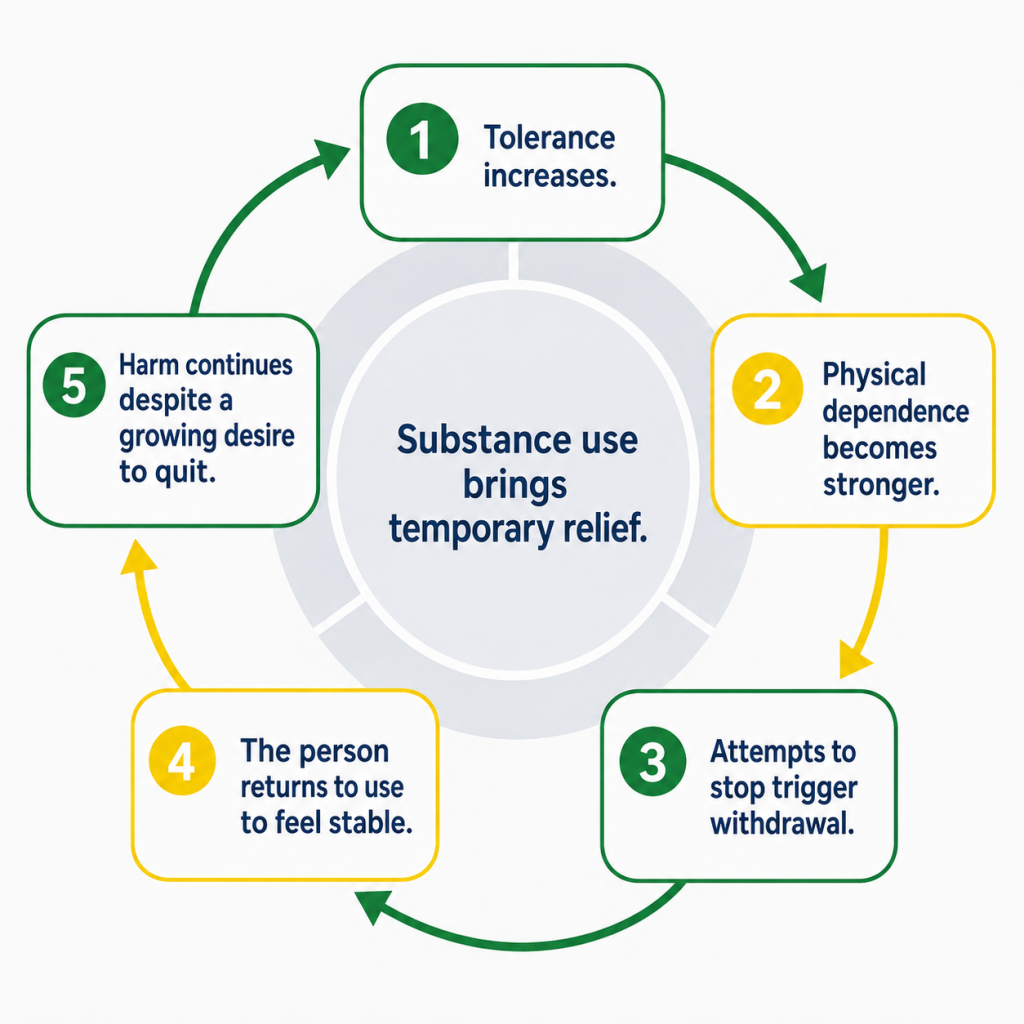
Fear of withdrawal can become one of the biggest barriers to contacting treatment.
A supervised detox program can address the immediate physical risks. Residential and continuing care can then focus on the behavioral, emotional, social, and psychiatric factors connected to addiction.
Treating only the withdrawal may leave the larger pattern untouched. Treating only the behavior without accounting for physical dependence may expose the person to unnecessary medical risk.
How Is the Right Level of Care Chosen?
Treatment recommendations should come from the full clinical picture, not from whether someone uses the word dependence or addiction.
During an admissions screening, the team may ask about:
- The substances or medications involved
- How much and how frequently they are used
- The time of the last dose or drink
- Current withdrawal symptoms
- Prior detox experiences
- Overdose or seizure history
- Prescription medications
- Medical diagnoses
- Mental health symptoms
- Effects on work, relationships, and daily responsibilities
- Previous efforts to stop
- The stability of the home environment
Someone with physical dependence may need medical detox or coordination with the prescribing clinician. Another person may need addiction treatment even when withdrawal risk is low.
When addiction and physical dependence occur together, treatment may begin with detox and move directly into residential care. Longer-term support can then help the client build new routines, work through co-occurring mental health needs, and prepare for life with less structure.
There is no benefit in choosing the least intensive option simply because it feels easier to accept. There is also no reason to place someone in residential treatment when a well-supported outpatient program safely fits their needs.
A personalized assessment helps identify that balance.
Midwest Recovery Centers Services
Midwest Recovery Centers provides comprehensive behavioral health care for patients seeking support for addiction, primary mental health concerns, and co-occurring conditions. Our connected clinical model allows us to provide coordinated care across multiple levels of treatment and ongoing support.
By maintaining smaller, more personalized treatment settings, we create an environment where clients can feel supported, respected, and heard. Our approach focuses on the whole person including mind, body, and spirit, while promoting inclusivity, equity, service, and continued growth.
Detox and Residential Treatment
Detox and Residential care make up the first 30 days of our substance use track.
During Detox, clients receive 24/7 support and medical oversight while alcohol or drugs leave the body. Medication-assisted treatment is offered during Detox only when clinically appropriate.
Residential care builds on that early stabilization through structured clinical programming, which may include:
- Cognitive behavioral therapy
- Acceptance and commitment therapy
- Dialectical behavior therapy
- Rational emotive behavior therapy
- Experiential group work
- Holistic activities
- Individual and group therapy
- Support-group integration
- Medical and psychiatric assessments
- Personalized treatment planning
- Goal setting and progress reviews
We treat substance use involving alcohol, heroin and other opioids, methamphetamine, cocaine, marijuana, prescription drugs, and multiple substances.
Phase 1 and Phase 2 Extended Care
Following the first 30 days of Detox and Residential treatment, clients may move into Phase 1 for approximately 60 days.
Phase 2 may continue for up to nine months, depending on the patient’s need. Housing is included in both phases.
These programs provide continuing inpatient-style structure while clients begin taking on more independence. The extended timeline creates space to practice coping skills, rebuild daily habits, strengthen accountability, and prepare for community life without making a sudden transition from residential care to complete independence.
Community IOP for Substance Use and Mental Health
We offer two Community Intensive Outpatient Programs:
- Community IOP for Substance Use Disorder
- Community IOP for Mental Health
Community IOP is designed for clients who do not want, or are not able, to commit to the long-term housing component. It may serve as a starting point or provide continued support after a higher level of care.
Both Community IOP tracks include access to medical oversight, which may involve:
- Medication management
- Psychiatric evaluations
- Transcranial Magnetic Stimulation
- Long-Acting Injectable medications
- PGx genetic testing
- Telemedicine
This structure allows clients to receive coordinated clinical support while continuing to live in the community and manage appropriate work, school, or family responsibilities.
Residential and Outpatient Mental Health Treatment
Our 45-day Residential Mental Health Program treats primary mental health disorders, not only symptoms that occur alongside addiction.
Treatment tracks are tailored to each client’s psychiatric, emotional, physical, and practical needs. Services may include therapy, psychiatric care, medication management, TMS, fitness, nutrition support, and whole-person activities.
Outpatient mental health services are also available. They may follow residential care, but residential treatment is not a requirement. A person may begin directly with outpatient services when that level of care fits their symptoms and current stability.
Co-Occurring Disorder and Clinical Care
Physical dependence, addiction, depression, anxiety, trauma symptoms, bipolar disorder, and other concerns can overlap.
Our shared care model helps clients address substance use and mental health together. Clinical services include medical and psychiatric assessments, individualized treatment plans, medication oversight, measurable goals, and continuing reviews of progress.
PGx genetic testing is available across all levels of care. It provides information about genetic factors that may affect how the body processes certain medications. The results can support prescribing decisions, but they do not diagnose addiction or guarantee that a particular medication will be effective.
Family Programming
Our Family Program provides education, counseling, connection, and practical support for loved ones affected by addiction or mental illness.
Virtual Substance Use Disorder Family Programming takes place on Thursdays from 6:30 to 8:00 p.m. Central Time. The four-part monthly rotation covers:
- Addiction education and family dynamics
- Enabling, healthy support, grief, and codependency
- Boundaries before, during, and after treatment
- Self-care, detaching with love, and changing family roles
The Virtual Family Program for Mental Health meets on the third Thursday of each month at 8:00 p.m. Central Time.
Our in-person session, “Supporting Their Next Steps: An Aftercare Info Session for Families,” takes place on the first Wednesday of each month at 7:00 p.m. at our Main Outpatient Campus, 13340 Holmes Road, Kansas City, Missouri 64145.
Aftercare
Our Aftercare program helps clients stay connected as they move from structured treatment into everyday life.
Support may include:
- Personalized continuing-care plans
- Counselor check-ins
- Individual or group therapy
- Relapse-prevention planning
- Goal reviews
- Community connection
- Adjustments as needs change
This ongoing contact can be especially valuable during the first year, when stress, relationships, work demands, and greater independence may reveal areas that still need attention.
A Clear Assessment Can Change What Happens Next
Physical dependence and addiction may require different forms of support, but both deserve appropriate care. Depending on the situation, treatment may involve medical supervision, therapy, psychiatric support, family involvement, or ongoing recovery services.
Our admissions team can help assess withdrawal risks, mental health concerns, and treatment needs to determine an appropriate starting point.
Reach out to Midwest Recovery Centers today for a confidential conversation and personalized guidance on what comes next.
FAQs
1. Can you be physically dependent without being addicted?
Yes. Physical dependence can develop when the body adapts to a medication or substance, even when it is taken exactly as prescribed and without compulsive use.
2. Can someone have addiction without physical dependence?
Yes. Addiction can involve cravings, loss of control, and continued substance use despite harm even when severe physical withdrawal symptoms are not present.
3. What is the difference between tolerance and dependence?
Tolerance means the same amount of a substance produces less effect over time. Dependence means the body has adapted and may experience withdrawal when the substance is reduced or stopped.
4. Does physical dependence always require detox?
Not always. Some people may need supervised detox, while others may require a gradual medication taper or medical monitoring based on the substance, withdrawal risk, and health history.
5. Why is it important to distinguish dependence from addiction?
The distinction helps determine the appropriate treatment approach. Physical dependence may require medical management, while addiction often requires broader behavioral, emotional, and ongoing clinical care.